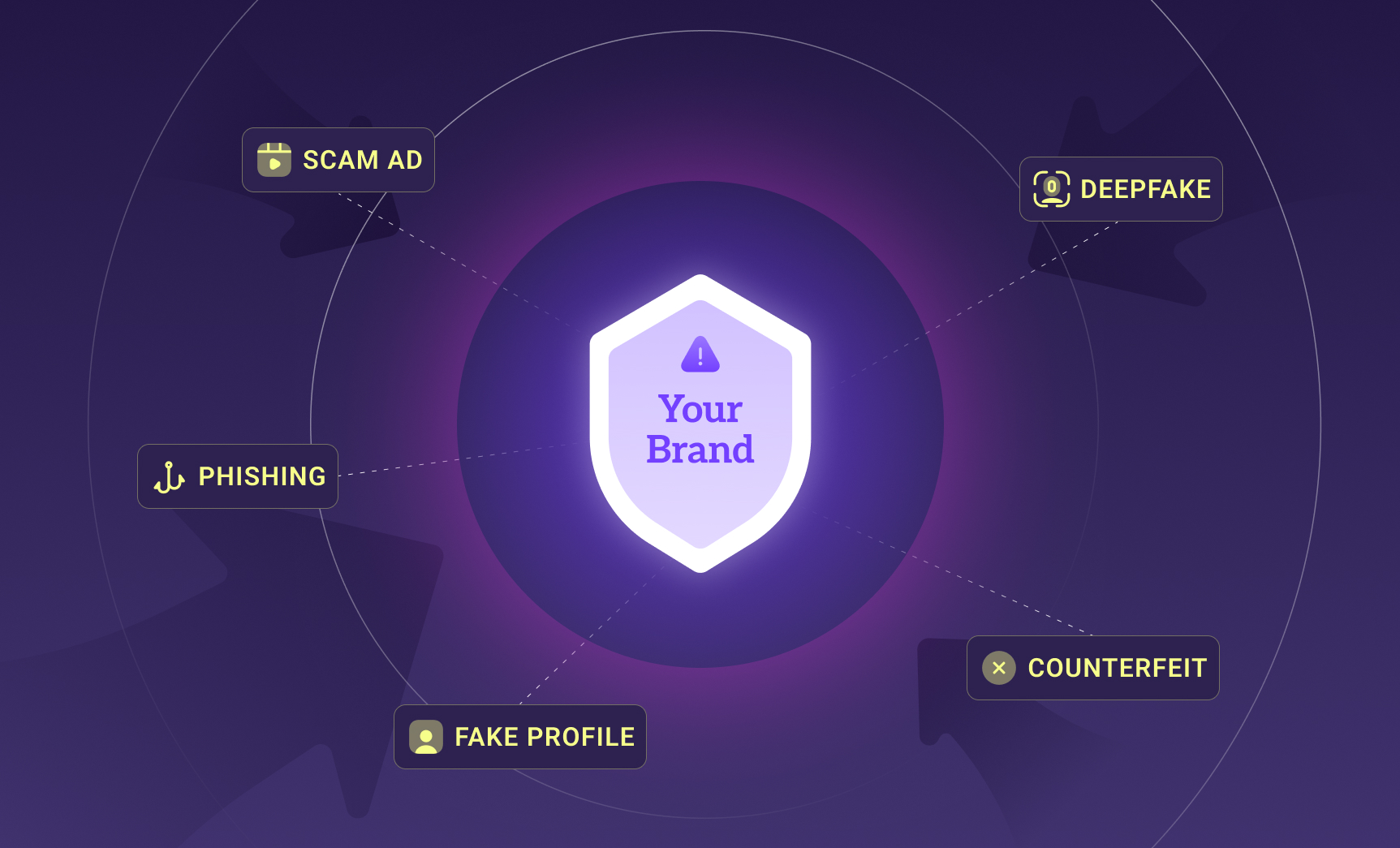
Online brand abuse is the unauthorized use of a brand’s identity, assets, or reputation across digital channels to deceive users, divert revenue, or cause reputational harm. Unlike traditional counterfeiting or trademark infringement that occurs in physical spaces, online brand abuse happens across websites, social media platforms, marketplaces, and digital channels where attackers can operate with relative anonymity and at massive scale.
Common Forms of Online Brand Abuse
Online brand abuse takes several forms, each designed to exploit trust, redirect value, or damage reputation. As attackers adopt AI-generated content and automation, these tactics are becoming more scalable and harder to detect.
Impersonation & Phishing
Scammers create fake websites, social media accounts, or messages that mimic legitimate brands. These are used to steal credentials, distribute malware, or redirect payments. A user may land on what appears to be a real login page or receive a convincing support message, only to have their information compromised.
Counterfeiting
Bad actors use brand assets to sell fake products through online marketplaces and fraudulent storefronts. These listings compete directly with legitimate channels, erode revenue, and expose customers to low-quality or unsafe goods.
Domain Abuse & Typosquatting
Attackers register domains that closely resemble legitimate brand names, often using misspellings or alternate characters. These domains are used to capture misdirected traffic or host phishing pages, malware, or counterfeit product listings.
Reputation Attacks
Malicious actors spread false claims, coordinate fake reviews, or publish misleading content to damage brand credibility. These campaigns can scale quickly and influence customer perception before a response is possible.
AI-Generated and Synthetic Threats
Advanced attacks now include deepfake videos, cloned voices, and AI-generated phishing messages that closely replicate real communications. These tactics increase the effectiveness of impersonation and make fraudulent content harder for both users and systems to identify.
Stopping these threats requires coordinated detection, prevention, and enforcement across the same environments where abuse occurs.
Online Brand Abuse: Threat Types, Impact, and Defense Strategies
| Online Brand Abuse Type | How It Damages Your Brand | Detection Method | Prevention Method | Response Method |
| Impersonation & Phishing | Stolen credentials, malware distribution, customer fraud | Social media monitoring, domain scanning | Brand consistency, customer education | Automated takedowns, account removal |
| Counterfeiting | Lost revenue, damaged reputation, customer harm | eCommerce monitoring, product verification | Trademark enforcement, domain ownership | Swift removal, legal action |
| Domain Abuse (Typosquatting) | Traffic redirection, customer confusion, phishing | Domain registry monitoring | Own key extensions, gTLDs | Takedown requests, legal enforcement |
| Negative Reputation (False Info) | Trust erosion, customer loss, brand damage | Review monitoring, sentiment analysis | Authentic messaging, employee advocacy | Content removal, reputation repair |
| AI-Generated Threats | Deepfakes, fake videos, sophisticated phishing | AI detection tools, content analysis | Authenticity tags, team training | Rapid response, platform reporting |
26 Ways to Stop Online Brand Abuse
The following 26 ways provide a systematic approach to stopping online brand abuse before it damages your revenue, reputation, and customer trust.
DETECTION & MONITORING
1. Deploy AI-Powered Trademark Monitoring Automated tools scan the internet continuously for unauthorized use of your brand name, logos, and taglines across websites, social media, and marketplaces. AI detection catches variations and similar marks that manual monitoring would miss.
2. Monitor Counterfeit eCommerce Sites Use web monitoring solutions to identify fraudulent storefronts selling fake versions of your products. These sites often appear in search results or social media ads, directly competing with legitimate sales channels.
3. Scan Domain Registries for Typosquatting Monitor domain registration databases for newly registered domains containing your brand name or close variations. Early detection prevents these domains from becoming established phishing or counterfeit hubs.
4. Track Social Media Impersonation Monitor social platforms for fake accounts using your brand name, logo, or verified-looking profiles. Modern impersonators use deepfake avatars and copied branding to appear legitimate.
5. Detect AI-Generated Threats Implement monitoring for deepfakes, fake videos of executives, and AI-generated phishing emails. These threats are increasingly sophisticated and require specialized detection capabilities.
6. Quantify Your Brand Risk Use risk assessment dashboards to evaluate threat likelihood, business impact, and urgency. Data-driven risk scoring helps prioritize response efforts on the most damaging threats.
PREVENTION & HARDENING
7. Register Your Trademark Early Establish trademark protection before bad actors claim similar marks. Early registration strengthens your legal position and makes enforcement more straightforward.
8. Enforce Your Trademark Aggressively Don’t let infringements slide. Consistent enforcement signals to bad actors that your brand is actively protected, deterring future abuse attempts.
9. Own Key Domain Extensions Register your brand across .com, .net, .org, and emerging gTLDs (.shop, .store, .ai). Owning these extensions prevents bad actors from registering them and reduces typosquatting opportunities.
10. Maintain Consistent Brand Identity Align your visual identity, tone, and messaging across all channels. Consistency makes it easier for customers to distinguish real from fake and harder for scammers to create convincing impersonations.
11. Activate Employee Advocacy Encourage employees to share authentic brand content and represent the company legitimately online. Authentic voices amplify legitimate messaging and make it harder for scammers to confuse customers.
12. Educate Customers on Verification Provide clear guidance on how to verify legitimate accounts, products, and communications. A customer who knows what to look for is less likely to fall victim to impersonation.
RESPONSE & ENFORCEMENT
13. Develop a Comprehensive Brand Protection Plan Create a documented strategy that defines what qualifies as a threat, assigns ownership for response, and establishes incident tracking protocols. A plan ensures consistent, coordinated response rather than reactive scrambling.
14. Create Incident Response Playbooks Build specific playbooks for different threat types: deepfakes, fake reviews, phishing campaigns, counterfeit sites. Playbooks enable faster response by removing decision-making delays.
15. Implement Automated Takedown Processes Manual takedown requests are too slow. Automated takedown systems identify threats and initiate removal requests across platforms without human intervention, dramatically reducing response time.
16. Enforce in Closed Environments Extend enforcement beyond mainstream platforms to Telegram, Discord, encrypted apps, and monitoring dark web marketplaces. Bad actors increasingly operate in hard-to-police environments where traditional enforcement doesn’t reach.
17. Prioritize Based on Risk Not all threats are equal. Focus enforcement resources on high-impact threats (revenue-diverting counterfeits, credential-stealing phishing) before addressing lower-priority impersonations.
18. Track Repeat Offenders Maintain records of bad actors and their tactics. Repeat offenders often use similar methods, allowing you to identify and stop them faster on subsequent attempts.
EMERGING THREATS
19. Defend Against Deepfakes Implement detection tools for deepfake videos and audio impersonating executives or brand representatives. Establish protocols for rapid response when deepfakes surface.
20. Monitor for Fake Reviews Track review platforms for coordinated fake reviews designed to damage your reputation or boost competitors. Fake review campaigns can significantly affect customer trust and purchasing decisions.
21. Combat AI-Generated Phishing AI-generated phishing emails are increasingly difficult to distinguish from legitimate communications. Train teams to identify sophisticated phishing attempts and implement email security tools designed for AI-generated threats.
22. Use Authenticity Tagging Add watermarks, digital signatures, or authenticity tags to official content (videos, press releases, product images). Authenticity markers help customers verify legitimate content and identify fakes.
23. Train Teams on Sophisticated Impersonation Educate your team to recognize advanced impersonation tactics: verified-looking accounts, deepfake avatars, copycat handles, and social engineering techniques. Internal awareness prevents employees from becoming vectors for brand abuse.
STRATEGIC IMPLEMENTATION
24. Partner with a Brand Protection Provider Choose a specialized brand protection service that offers automation, enforcement capabilities, and visibility across platforms. Manual processes are no longer sufficient at scale.
25. Create a Customer Reporting Workflow Establish an easy way for customers to report suspected impersonation, fake accounts, or counterfeit products. Automate the processing of these reports to identify patterns and prioritize response.
26. Monitor and Update Quarterly Brand protection is never “set and forget.” Review incident data, threat trends, and emerging tactics quarterly. Update your strategy based on what you’re seeing in the threat landscape. Track KPIs like time-to-takedown, total impersonation attempts, platform-specific trends, and repeat offender rates.
BUILDING YOUR ONLINE BRAND ABUSE DEFENSE
Online brand abuse requires a multi-layered approach. Detection is the first step—you must also prevent exposure, respond swiftly when threats emerge, and continuously adapt to new attack vectors.
The brands that successfully stop online brand abuse are those that treat it as an ongoing operational priority, not an occasional concern. Implement these strategies systematically, measure your progress, and adjust as the threat landscape evolves. Your brand’s digital identity is too valuable to leave unprotected.
Want to get started? Learn more about Bolster AI’s domain monitoring and contact us today.