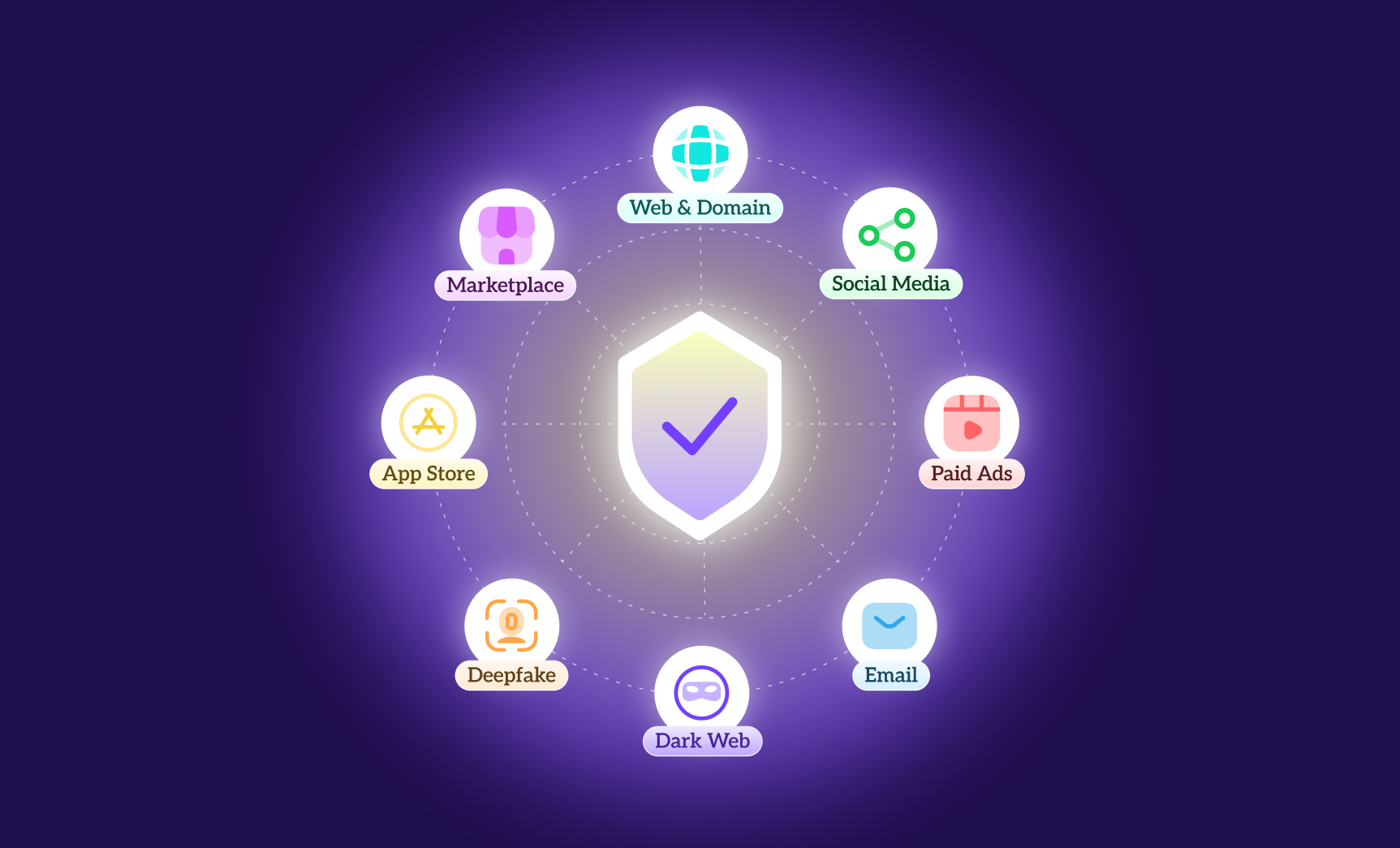
Someone is pretending to be your company right now. Maybe it’s a lookalike domain collecting your customers’ credentials. Maybe it’s a fake LinkedIn profile impersonating your CEO or a paid ad on Meta running your logo next to a scam offer. Brand impersonation has become one of the fastest-growing external threats facing enterprises, and most organizations are only protecting against a fraction of it.
This guide breaks down what brand impersonation actually looks like in 2026, where it happens, how to evaluate the solutions built to stop it, and which platforms are leading the way.
What Is Brand Impersonation?
Brand impersonation is when threat actors use your company’s name, logos, visual identity, or executive likenesses to deceive customers, partners, or employees. The goal is almost always the same: exploit the trust your brand has built to steal credentials, money, or sensitive data.
It’s important to distinguish brand impersonation from related but different problems. Trademark infringement and counterfeiting are legal and intellectual property issues. Email spoofing is one narrow tactic within the broader impersonation playbook.
Brand impersonation encompasses all of these and more. It’s a security problem, not just a legal or marketing one, and it requires a security-oriented response. The scope is what makes it dangerous. Attackers don’t limit themselves to one channel. A single impersonation campaign might involve a typosquatted domain hosting a phishing page, a fake social media profile driving traffic to it, and a paid ad amplifying the reach. Each component reinforces the others, and each requires different detection and enforcement mechanisms to shut down.
Why Brand Impersonation Is Accelerating
The scale of brand impersonation has grown dramatically:
- The Anti-Phishing Working Group recorded over 1 million phishing attacks in Q1 2025, the highest volume since late 2023.
- Meta removed more than 159 million scam ads in 2025 and took down 10.9 million accounts on Facebook and Instagram tied to criminal scam centers.
- The FTC reported $2.7 billion in US losses from social media scams, with social platforms serving as the origin point for 76% of all reported fraud cases.
Three forces are driving this acceleration:
- Generative AI has eliminated the skill barrier. Attackers no longer need design talent or language fluency to create convincing phishing pages, fake profiles, or scam ads. AI tools can clone a brand’s visual identity and generate polished, localized content in seconds.
- The attack surface keeps expanding. Every new platform, app store, ad network, and messaging channel is another place where your brand can be impersonated. Attackers move to wherever protection is thinnest.
- Most organizations still treat this as an email problem. They’ve invested in inbound email security (DMARC, SPF, DKIM, secure email gateways) but haven’t addressed the external channels where impersonation actually reaches their customers. That gap is exactly what attackers exploit.
Where Brand Impersonation Happens
The most common mistake in brand impersonation protection is assuming it’s a single-channel problem. It isn’t. Here’s where impersonation campaigns actually operate.
Lookalike Domains and Phishing Sites
Attackers register domains that closely resemble your legitimate URLs using typosquatting, homoglyph characters, or creative subdomain structures. These domains host phishing pages designed to harvest credentials or distribute malware. Modern phishing sites are pixel-perfect replicas that can fool even cautious users, and many use geo-fencing and conditional delivery to show different content to security scanners than they show to real victims.
Social Media Impersonation
Fake brand pages, fraudulent customer support accounts, and impersonated executive profiles are rampant across Facebook, Instagram, LinkedIn, X, TikTok, Telegram, and more. Attackers use these profiles to redirect victims to phishing sites, run advance-fee fraud, or harvest personal data through fake giveaways and promotions. The barrier to entry is essentially zero: creating a convincing fake profile takes minutes.
Platforms’ own detection systems are inconsistent at catching impersonation before it reaches real users. That’s why continuous social media monitoring has become a baseline requirement. Social media impersonation is also uniquely damaging because it plays out in public. When customers interact with a fake brand account, the reputational fallout extends well beyond the individual victim.
Paid Ad Abuse
Scam ads on Meta, Google, and other ad platforms use your brand’s name, logo, and imagery to drive traffic to phishing sites or counterfeit storefronts. These ads are often highly targeted, reaching the same demographics your legitimate marketing campaigns target. Because they run through the platform’s official ad infrastructure, they carry an implicit layer of trust that organic scam content doesn’t.
App Store Fraud
Fake or trojanized apps appear in Apple’s App Store, Google Play, and hundreds of smaller app marketplaces using your brand name and visual assets. These apps can harvest credentials, install malware, or charge users for fake services. Detecting them requires continuous monitoring across 500+ global app stores, not just the major two.
Learn more about marketplace monitoring with Bolster AI
Executive and Employee Impersonation
Fake LinkedIn profiles impersonating your CEO, CFO, or other executives are used for BEC-style attacks, job scams, and social engineering. Deepfake audio and video have made these impersonations even more convincing. Autonomous AI agents can now maintain thousands of simultaneous conversations while personalizing each one using information scraped from public sources.
The Bolster AI Research Team found that brands now receive over 30,000 customer-reported “is this real?” inquiries per month, many triggered by impersonated executive identities. Fake job postings using your brand name are a growing subcategory, often used purely to harvest identity documents and personal data from applicants.
Dark Web and Underground Forums
Brand assets, phishing kits, and stolen customer credentials circulate on dark web forums and Telegram channels. Threat actors buy and sell ready-made impersonation toolkits that include cloned brand assets, pre-built phishing page templates, and lists of target customers. Monitoring this activity provides early warning before campaigns go live.
Brand Impersonation vs. Brand Protection: What’s the Difference?
These terms get conflated constantly, but they describe different problems with different solutions.
Brand protection is the broader category. It encompasses counterfeiting, trademark enforcement, grey market goods, MAP violations, and unauthorized resellers. The buyers are typically legal, compliance, or brand marketing teams, and the solutions lean heavily on IP enforcement workflows.
Brand impersonation is a security problem. It’s about threat actors posing as your brand to steal credentials, commit fraud, or compromise customer data. The buyers are security operations leaders, CISOs, and risk teams. The solutions require real-time detection, automated takedowns, and correlated threat intelligence.
There’s overlap, of course. A counterfeit storefront that uses your brand assets is both a brand protection issue and an impersonation threat. But the toolsets, response workflows, and speed requirements are fundamentally different.
If you’re evaluating solutions, make sure you understand which problem you’re actually solving. (For a deeper look at how digital risk protection fits into this landscape, we’ve covered the category in detail.)
How to Evaluate Brand Impersonation Protection Solutions
Not all solutions are built the same way. Here’s what to look for.
Channel Coverage
The single most important differentiator. Impersonation campaigns span multiple platforms by nature. A fake LinkedIn profile linking to a phishing domain that drives traffic to a counterfeit storefront is one coordinated campaign, not three separate incidents. Ask:
- Does the solution monitor domains, social media, paid ads, app stores, dark web, and email?
- Can it connect signals across platforms to surface coordinated campaigns?
- Or does it only cover one or two channels, leaving you to stitch the picture together yourself?
Detection Speed and Accuracy
Modern phishing URLs often stay active for less than an hour. If your solution runs periodic scans rather than continuous monitoring, threats can reach thousands of victims before you even know they exist. Look for AI-powered detection that combines natural language processing, computer vision, and deep learning to classify threats in real time, not just pattern-match against known indicators.
Takedown Speed and Effectiveness
Detection without enforcement is just expensive awareness. Key questions:
- What’s the median time from detection to takedown?
- Does the vendor have direct API integrations with registrars, hosting providers, and social media platforms, or are they sending emails and waiting?
- Does the platform monitor for threat recurrence after a takedown is completed?
The difference between automated takedowns that resolve in minutes and manual processes that take days or weeks is often the difference between stopping a campaign and watching it run its course.
AI and Automation vs. Human-in-the-Loop
Fully automated systems can miss nuanced threats. Fully manual approaches don’t scale. The best solutions are mostly AI-driven with human analysts stepping in for edge cases and complex threats.
Ask vendors specifically how they handle false positives, novel attack patterns, and coordinated campaign attribution. The answer will tell you a lot about operational maturity.
Reporting and Visibility
Security leaders need impersonation data for board-level reporting. Operational teams need it to prioritize response. Make sure you can see:
- Full scope of impersonation targeting your brand
- Trend data over time and attack patterns by channel and geography
- Takedown status, resolution rates, and time-to-remediation metrics
A platform that gives you unified visibility across your full external attack surface is significantly more valuable than one that silos reporting by threat type.
Top Brand Impersonation Protection Platforms
Here’s a snapshot of the leading platforms in this space, evaluated against the criteria above.
Bolster AI offers the broadest channel coverage in the category, monitoring domains, social media (18+ platforms), app stores (500+), paid ads, email, and the dark web from a single platform. Detection is AI-driven with 99.999% accuracy, and 75% of takedowns resolve in under 60 seconds. Human analysts handle edge cases and complex campaigns.
The platform connects signals across every surface it monitors, so a phishing domain linked to a fake social profile linked to a scam ad is surfaced as one coordinated campaign. Major security vendors, including Akamai, have chosen to power their own brand protection offerings with Bolster AI’s technology.
Netcraft is strong in phishing and domain-based takedowns with fast median response times and deep, long-standing relationships with registrars and hosting providers. Their heritage in internet infrastructure gives them credibility in the domain-focused segment. Social media, marketplace, and app store coverage is more limited, so organizations using Netcraft often need to supplement with additional tools for non-web channels.
ZeroFox built its reputation on social media and digital engagement monitoring with solid brand abuse detection across Facebook, LinkedIn, and X. They also offer dark web monitoring and physical security intelligence for executive protection use cases. The platform leans more heavily on manual analyst review in the takedown process, which can introduce delays compared to more automated alternatives.
Doppel positions itself as an AI-native social engineering defense platform. It’s a newer entrant focused on detection and response for impersonation across digital channels, with growing capabilities in automated enforcement. Worth watching as the platform matures, particularly for organizations evaluating next-generation approaches.
BrandShield is particularly effective at detecting lookalike websites and fake profiles targeting customers with credential theft. It monitors across social media, websites, and app stores, with strength in high-trust industries like financial services and pharmaceuticals. Channel breadth doesn’t match the most comprehensive platforms, but it’s a solid option for organizations where customer-facing fraud is the primary concern.
Allure Security differentiates with patented deception technology that injects fake data into phishing sites to disrupt attacker operations and degrade the economics of targeting your brand. Their managed service model handles detection through takedown, with a focus on preemptive scam detection across web, social, and mobile.
Memcyco focuses on real-time credential protection at the browser level, detecting when users interact with impersonation sites and intervening during live sessions. It’s a strong complement to broader detection platforms but doesn’t cover the full takedown lifecycle.
Getting Started with Brand Impersonation Protection
If you’re evaluating your current exposure, start with three questions.
- Which channels are you actually monitoring today? Most organizations have domain monitoring and email authentication in place but lack visibility into social media impersonation, app store fraud, paid ad abuse, and dark web activity. The channels you’re not watching are the ones attackers will use.
A thorough audit of your brand’s digital footprint, including all authorized accounts, domains, and apps, is a necessary first step to understanding the scope of potential impersonation. - How fast can you respond when a threat is detected? If your current process involves manual triage, email-based takedown requests, and multi-day resolution timelines, you’re giving campaigns plenty of time to reach your customers. Measure your mean time from detection to takedown and compare it to what modern automated platforms can deliver.
- Can you see the full picture? Fragmented tools that monitor one channel each create blind spots and duplicate work. A unified platform that connects signals across domains, social media, app stores, and the dark web gives you the context needed to understand coordinated attack campaigns rather than isolated incidents.
That connected visibility is also what enables you to report on external threat exposure at the board level, moving the conversation from reactive incident counts to proactive risk management.
Brand impersonation isn’t slowing down. AI-generated content, expanding platform surfaces, and industrialized fraud operations mean the volume and sophistication of attacks will only increase. The organizations that get ahead of this threat are the ones investing in automated, comprehensive detection and takedown now, before the next campaign targets their customers.