Your brand protection strategies probably are not failing on intent. They are failing on timing.
You have a trademark filing. You have a registrar account. You have someone in legal who sends takedown requests. What you likely don’t have is a way to find a cloned login page, a fake storefront, or a deepfaked video of your CEO within minutes of it going live.
That gap is where the losses happen. The FBI’s Internet Crime Complaint Center tied phishing and spoofing to more complaints than any other cybercrime category in 2024, with $16.6 billion in reported losses, up 33% year over year. Attackers now launch hundreds of near-identical domains at once using off-the-shelf kits. A quarterly review and a manual abuse email cannot absorb that volume.
Most tools stop at detection and hand you a longer alert queue. Bolster AI manages the full lifecycle, from detection through takedown and post-removal monitoring.
Below are 12 brand protection strategies for 2026: the threat each one addresses, how to execute it now that attacks are automated, and the KPIs that tell you it is working.
What Is Brand Protection?
Brand protection is the set of legal, technical, and operational measures you use to defend your brand identity, intellectual property rights, and customer relationships from misuse.
Digital brand protection narrows that to online threats: typosquatted domains, social account impersonation, counterfeit marketplace listings, phishing sites, fake mobile apps, and AI-generated fraud.
The distinction matters because the two run on different clocks. Legal enforcement moves in weeks. Online attacks move in hours.
The 12 Strategies at a Glance
| Strategy | Threat it addresses | How to execute it in 2026 | KPIs to track |
| 1. Protect your trademarks | Unauthorized use of names, logos, taglines | Continuous AI monitoring across domains, marketplaces, and web content | Infringements detected, time to enforcement |
| 2. Protect your domain names | Typosquatting, lookalike domains, phishing infrastructure | New-gTLD coverage, certificate transparency alerts, automated takedown | Domains neutralized, detection-to-takedown time |
| 3. Monitor social media | Account impersonation, fake giveaways, deepfake profiles | Handle-variation detection, logo matching, direct platform reporting | Impersonation volume, platform takedown rate |
| 4. Detect counterfeits | Fake products on marketplaces and social commerce | Image similarity scanning, seller network analysis, product verification | Listings removed, repeat seller rate |
| 5. Keep your branding consistent | Customer confusion and trust erosion | Verified channels, published official account list, employee advocacy | Customer-reported fraud, trust signals |
| 6. Quantify your brand risks | Unprioritized or invisible threats | Risk scoring from internal incident data plus external threat intel | Risk severity mix, high-risk trend velocity |
| 7. Document your plan | Slow or inconsistent incident response | Playbooks, ownership mapping, AI-threat response workflows | Response time, plan adherence |
| 8. Engage a provider | Manual enforcement bottlenecks | Automated detection and takedown across open and closed platforms | Takedown volume, mean time to resolution |
| 9. Monitor and update | Outdated controls, new attack methods | Quarterly review, trend analysis, control tuning | Threat growth rate, control effectiveness |
| 10. Prepare for AI threats | Deepfakes, synthetic phishing, fake executive content | Executive likeness monitoring, AI content detection, verification protocols | AI-driven incidents detected, response time |
| 11. Educate customers and staff | Human error, delayed reporting | Training, reporting workflows, automated abuse-mailbox triage | Reported incidents, training completion |
| 12. Protect your supply chain | Partner impersonation, third-party misuse of your brand | Vendor monitoring, partner domain scanning, usage enforcement | Third-party incidents, remediation time |
1. Protect Your Trademarks
Trademark protection is the legal foundation everything else sits on. Register early, register across the classes and territories you actually sell in, and enforce consistently. A mark you do not defend gets harder to defend later.
Detection is the part most teams underinvest in. Trademark infringement rarely announces itself in a filing database. It shows up as your logo lifted onto a fake checkout page, or your product name on a marketplace you have never sold through.
How to execute it: Use AI-powered trademark monitoring to detect similar names, logos, and taglines across domains, marketplaces, and web content automatically. Bolster AI flags brand infringement in the first hours of a campaign, which costs you far less than litigating it in month six.
2. Protect Your Online Domain Names
Attackers register lookalike domains because domains are cheap and disposable. One brand can generate hundreds of viable typosquat variations across the current TLD space. Defensively registering all of them is not economically sensible.
Coverage plus speed works better. Watch the registration and certificate data, then remove the malicious ones fast.
How to execute it: Register your brand across the gTLDs your customers actually use (.shop, .store, .ai), then run continuous domain monitoring with alerts on new registrations containing your brand string. Bolster AI’s typosquatting protection generates up to 300 typosquat variations per brand domain across 1,500+ TLDs and watches all of them. A commissioned Forrester Total Economic Impact study found $315,000 per year in avoided defensive domain registration costs for a composite Bolster AI customer.
3. Monitor Social Media
Brand impersonation on social platforms has moved past the obvious fake account with 40 followers. Attackers use copycat handles that differ by one character, cloned bios, scraped post history, and AI-generated avatars that pass a quick glance.
Exact-match search will not find these. You need variation detection and visual matching.
How to execute it: Cover the platforms where your audience actually is. TikTok, Instagram, Facebook, YouTube, and LinkedIn carry the mainstream volume. Telegram, Discord, and WhatsApp carry the closed-environment fraud. Bolster AI monitors 14+ platforms, automates handle-variation detection and logo matching, and holds a direct backend takedown API with Telegram. That matters, because Telegram scams and other social media scams increasingly start in channels that ignore standard abuse reports.
4. Detect Counterfeits Across Marketplaces
Counterfeit goods take your revenue, generate support tickets you pay for, and hand a customer a bad product with your logo on it. Social commerce and cross-border marketplaces have made the listings faster to create and harder to trace to one seller.
Manual marketplace searching does not scale past a few dozen SKUs.
How to execute it: Use image similarity scanning and seller network analysis to find counterfeit listings, including the ones that keep your brand name out of the title and rely on your product photos instead. Bolster AI’s marketplace monitoring and takedowns module handles detection and removal in one workflow, at up to 20x lower cost per action than UDRP-style enforcement. Add invisible watermarking or QR-based verification so your customers can confirm authenticity themselves.
5. Keep Your Branding Consistent
This is the cheapest strategy on the list and the one teams skip most often. Consistent visual identity, tone, and verified communication channels make fakes easier for your customers to spot.
Inconsistency is what fraudsters exploit. Every off-brand microsite, unverified regional account, and one-off campaign domain gives them cover.
How to execute it: Audit and consolidate your owned channels, publish a public list of official accounts and domains, and use employee advocacy to amplify authentic voices. In a competitive market, a coherent brand image is both a marketing asset and a fraud control.
6. Quantify Your Brand Risks
Identifying risks is easy. Ranking them changes how you spend. A cloned login page for your banking portal and a fake T-shirt on a marketplace are both brand incidents, but they carry very different exposure.
Score each risk by likelihood, business impact, and customer harm. Then send automation to the top of that list first.
How to execute it: Combine your internal incident data with external threat intelligence in a risk heatmap you can show a CFO. Attach a dollar figure to each tier where you can: fraud loss, support cost, churn, and erosion of brand equity all belong on that sheet. Bolster AI Signals turns your telemetry into peer benchmarks and board-ready reporting, so the numbers survive scrutiny.
7. Document Your Brand Protection Plan
A brand strategy that covers positioning and messaging but says nothing about enforcement leaves an obvious gap. Write down what qualifies as a threat, who owns each response, what the escalation path is, and how you track incidents.
Speed is the reason this matters. Ambiguity about ownership is the most common cause of a 48-hour delay on a takedown that should have taken a minute.
How to execute it: Build a playbook per threat type (domain, social, app store, marketplace, deepfake). Assign a named owner to each. Define the criteria that trigger automated action with no human review. If you operate in a regulated industry, keep exportable evidence of what you found, when, and how you resolved it.
See what is already out there. Get a free look at the typosquats and lookalike domains targeting your brand right now. Scan your domain with CheckPhish.
8. Engage a Brand Protection Provider
At a certain volume, in-house enforcement stops working. Abuse emails sit in queues. Your analysts spend their hours collecting evidence instead of investigating. Takedowns that need a registrar relationship stall, because you do not have one.
The right brand protection solution replaces that queue with direct integrations. Here is the difference in practice:
| Process | Manual approach | With Bolster AI |
| Detection | Customer reports, periodic manual searches | Continuous AI scanning across web, social, app stores, marketplaces, and the dark web |
| Validation | Analyst reviews each candidate by hand | Computer vision verdicts in under 300ms, with a human SOC team on edge cases |
| Escalation | Abuse email to a shared inbox, then wait in queue | Direct API submission to 1,500+ registries and hosting providers |
| Removal | 10 to 12 days industry average | 75% complete in under 60 seconds |
| After removal | Case closed | Continuous monitoring for rebuilds on new infrastructure |
How to execute it: Ask vendors what percentage of takedowns complete with no human intervention, rather than asking for an average time. Ask about coverage in closed environments like Telegram, WhatsApp, and dark web marketplaces. Ask what happens after removal, because attackers rebuild. Bolster AI’s automated takedown platform resolves 75% of cases in under 60 seconds and 95% with no manual intervention. If ZeroFox is on your shortlist, our Bolster AI vs ZeroFox comparison breaks down where each approach fits.
9. Monitor and Update Your Strategy
Brand protection is not a project with an end date. Attack methods shift, platforms change their reporting rules, and your digital footprint grows every quarter.
Review the data on a fixed cadence, then change something based on it.
How to execute it: Run a quarterly review against four KPIs: mean time to takedown, total impersonation attempts, platform-specific threat trends, and repeat offender rate. If your mean time to takedown stays flat while attempt volume climbs, your coverage is the problem, not your response.
10. Prepare for AI-Generated Brand Threats
Deepfaked executives, synthetic audio, AI-written phishing, and fabricated reviews are standard attacker tooling now. The Bolster AI 2026 Fraud Trends and Prediction Report found that 72% of impersonation sites mimic a full customer journey, from login through checkout to support chat, rather than a single fake page. The longer your customer stays engaged, the more you lose.
The financial side is already measurable. As KuCoin reported, AI-generated video clones of well-known executives drove $577 million in verified losses through giveaway scams in the first four months of 2026.
How to execute it: Add executive likeness monitoring, AI content detection, and internal verification protocols for financial and communications requests. Train your team to identify deepfakes, watch for AI-generated reviews and profiles, and watermark official video and press content. Bolster AI’s deepfake detection covers executive impersonation across video, audio, and image, and routes confirmed cases straight into the takedown workflow.
11. Educate Your Customers and Team
Your customers and employees are often the first to see a fake, and frequently the last to report it. Make reporting obvious and fast, then make sure those reports reach something that acts on them.
The volume is significant. Enterprises Bolster AI surveyed receive an average of 30,000 phishing reports per month through customer support inboxes, and roughly 1 in 3 turns out to be a real threat.
How to execute it: Publish short guides on verifying official accounts and products. Create one internal “report impersonation” workflow with a single destination. Then automate the triage. Bolster AI’s customer abuse mailbox ingests and classifies reported emails and starts takedowns without an analyst opening each one.
12. Protect Your Supply Chain
Your exposure does not stop at the assets you control. Distributors, resellers, logistics partners, and vendors all use your name, and each one is a route to your customers. A fake partner portal or a spoofed vendor invoice damages your brand reputation even though it never touched your infrastructure.
How to execute it: Vet third-party sellers, write brand usage requirements into vendor contracts, and extend monitoring to partner landing pages, support channels, and login portals. Watch dark web forums for leaked credentials and stolen brand asset files, which often signal a partner compromise before it becomes customer-facing. Bolster AI’s dark web monitoring covers forums, underground marketplaces, and Telegram channels for exactly this kind of third-party brand abuse.
Ready to see this running against your own exposure? Bolster AI shows you what is live against your brand today, and removes it in minutes rather than weeks. Request a Demo at bolster.ai.
Frequently Asked Questions
What is a brand protection strategy?
A brand protection strategy is a documented plan for detecting, prioritizing, and removing unauthorized use of your brand across digital channels. It covers trademark enforcement, domain monitoring, social media impersonation, counterfeit marketplace activity, mobile apps, and AI-generated content. An effective strategy names an owner for each threat type and sets a target response time for each one.
How do brand owners detect impersonation early?
You detect impersonation early by monitoring the signals that appear before an attack goes live: new domain registrations containing your brand string, certificate transparency logs showing TLS certificates issued for lookalike domains, newly created social handles with variant spellings, and marketplace listings that reuse your product photography. Automated monitoring catches these in minutes. Manual review usually finds them after a customer complains.
Is brand protection the same as trademark enforcement?
No. Trademark enforcement is the legal side: registering marks and pursuing infringers through formal channels. Brand protection is broader, covering the technical and operational work of finding and removing misuse online, including cases where no registered mark is involved. A phishing page using your logo may be actionable under copyright, and a lookalike domain may infringe nothing until someone weaponizes it.
How long does it take to remove a fake website?
It depends on the method. Manual reporting through a hosting provider’s standard abuse process averages 10 to 12 days industry-wide, because your request joins a queue with everyone else’s. Platforms with direct registrar and hosting integrations resolve most cases far faster. Bolster AI completes 75% of takedowns in under 60 seconds and 95% with no manual intervention.
Do fake sites come back after a takedown?
Often, yes. The same actor rebuilds on a new domain within days, reusing the same page templates, hosting setup, or contact details. Post-takedown monitoring belongs in your strategy rather than sitting outside it. Continuous digital risk protection catches the rebuild before it reaches the scale of the original campaign.
Who owns brand protection inside a company?
Ownership is usually split, which is exactly why you document it. Legal owns trademark filings and formal disputes. Security or the SOC owns phishing and infrastructure threats. Marketing and brand teams own channel consistency and customer communication. Fraud teams own financial loss. The strongest programs assign one accountable owner per threat type rather than per department.
How do you measure brand protection ROI?
Measure it across four buckets: fraud losses avoided, analyst hours reclaimed, defensive domain registration costs avoided, and vendor consolidation savings. A commissioned Forrester Total Economic Impact study found 278% ROI over three years for a composite Bolster AI customer, including $1.4 million in recovered productivity and $315,000 per year in avoided defensive domain spend.
What should you look for in a brand protection platform?
Look for five things: automated takedown rate rather than average takedown time, coverage across all six channels your attackers use, direct registrar and hosting relationships, a low false positive rate so your team is not triaging noise, and post-takedown monitoring. Ask each vendor to show you results against your own brand during evaluation, not a generic demo.
Close the Gap
If you change one thing this year, shorten the window between when a fake goes live and when it comes down. Every strategy above gets more valuable as that window closes. Trademarks, playbooks, and training all matter most when something behind them can act in seconds.
Bolster AI monitors your domains, social media, app stores, marketplaces, email, and the dark web continuously, then removes confirmed threats through direct integrations instead of abuse queues. Do not just monitor threats. Eliminate them, and protect the reputation you spent years building.
Ready to take control of your brand’s web presence? See what is live against your brand today and how fast it comes down. Request a Demo at bolster.ai.
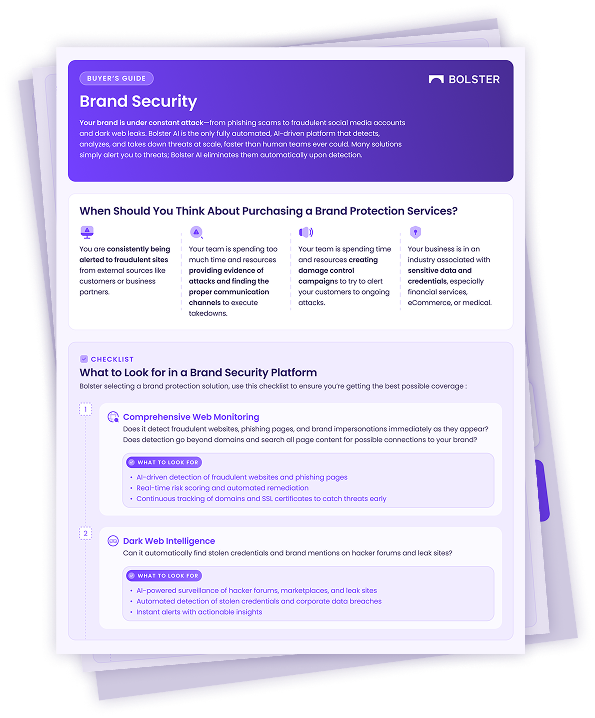
Still building your evaluation criteria? Download the Buyer’s Guide to Purchasing a Brand Security Solution.